
Why Drill Pipe Is a Harder Straightening Job Than It Looks
A drill pipe is not a length of bar stock. Treat it like one and you'll wreck it — usually at the ends, where nobody is looking.
The ends carry all the stress
Both ends of a drill pipe are upset. The wall thickens through a transition zone, then the tool joint takes over. That transition is where stress concentrates. If you push a bending force into it with a set of rolls, you can ovalize the tube or collapse the ID right at the fadeout, and the pipe is scrap before it ever goes back in the hole. Point-pressure straightening presses at defined positions on the pipe body and leaves the upset zone alone. That's the whole reason the process looks the way it does in the video — press here, not there.
Nine meters of steel wants to sag
Range 2 pipe runs roughly 9.1 to 9.8 m. Range 3 goes past 12 m. Support spacing and roller height matter more than people realize, because the pipe's own weight puts a sag in it that the measuring system will happily read as a bend. Get the supports wrong and you'll straighten a pipe into a shape that only looks correct while it's lying on the machine.
What a tolerance number actually refers to
When a supplier quotes 0.01 mm straightening accuracy, the honest question is: measured where? A single dial indicator reading at mid-span tells you almost nothing, because a drill pipe can read dead straight in the middle and still be out at two-thirds length. Multi-point inspection takes runout readings at several stations along the body and after the correction. Our machines work to 0.01 mm on long, heavy workpieces, and that figure means runout at defined stations — not one number from one spot. If a supplier can't tell you where they measure, the number on the datasheet is decoration.
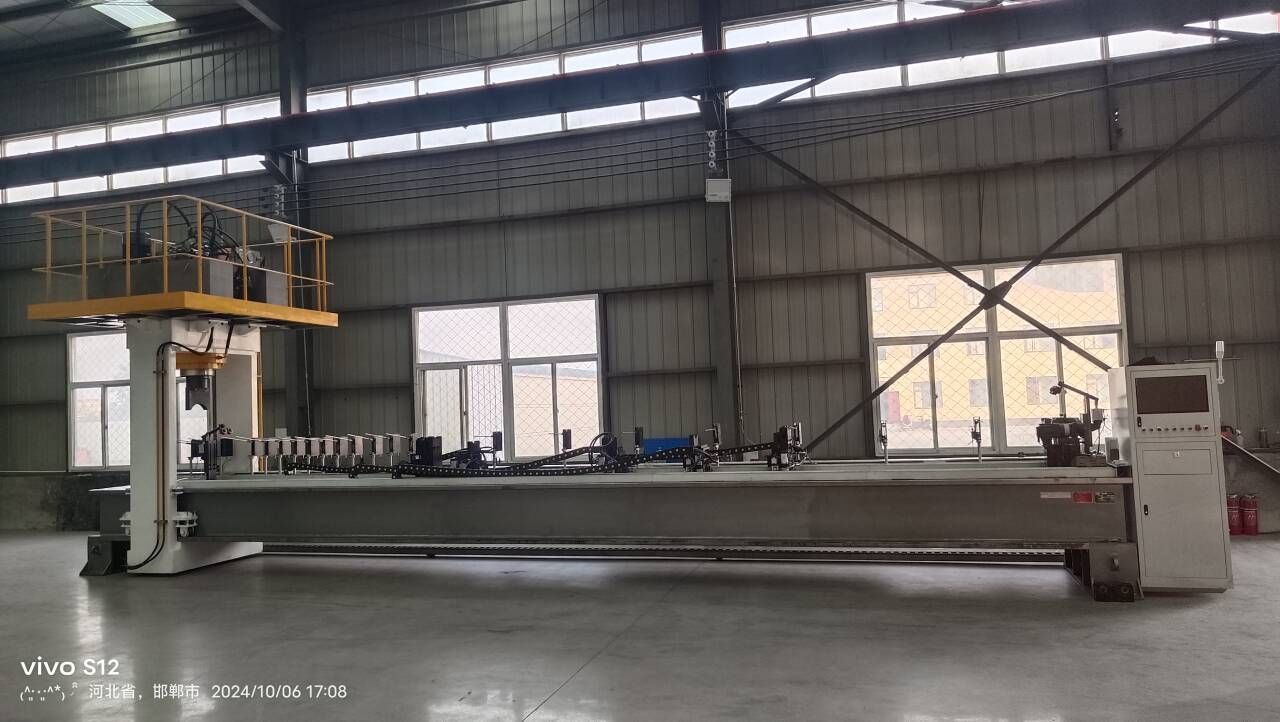
The machine doesn't start by bending anything. It starts by reading.
Measure first, then decide
The pipe indexes in, the probes take runout readings at multiple stations, and the controller builds a profile of the bend. From that profile it picks the high point — one location — and calculates a press depth. Not a blanket squeeze across the whole length. One stroke, one spot, with a deliberate overbend. The pipe springs back, relaxes, and gets measured again. The loop repeats until the runout falls inside tolerance, usually two to four strokes on a pipe that's been in service.
Springback is the whole game
How much steel gives back after you release the ram depends on grade, wall thickness, whether the pipe is new or has two years of downhole time on it, and how much the previous strokes already worked the material. Experienced operators develop a feel for this over years — they press a little past where they think they need to, and they're usually right.
We put that feel into a self-learning model instead. Every stroke's measured result gets fed back into the controller, so the predicted overbend for the next pipe of that spec gets a little closer. After a few hundred pieces the correction is tight, even on a size the machine hasn't seen before. It's the difference between a machine that runs a recipe and one that adjusts.
Why press instead of roll
Roller straighteners are fast and they're everywhere. They also leave a spiral of shallow marks down the pipe body, and on drill pipe those marks sit right next to a thread that's going to be inspected. Point-pressure contact is localized and controlled. No scratches, no indentations, no work-hardened band the next inspection will flag. If your pipe is going back into a string, that matters more than cycle time.
Running It: Throughput, Records, and Used Pipe
Straightening is one step in a repair flow. The part that eats labor is the handling.
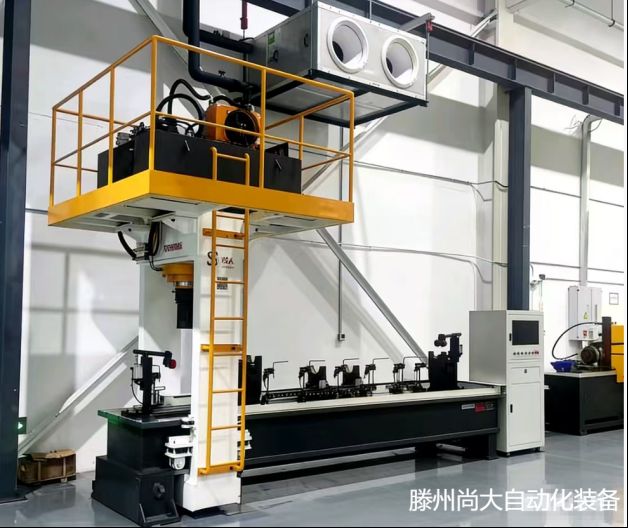
Handling is the real bottleneck
Nine meters of pipe is awkward, heavy, and wants to roll. Automated infeed, transfer, and outfeed take that out of the operator's hands, and the machine takes the queue and works through it. In practice the straightening step runs three to five times faster than a manual press with a skilled operator, and the operator's job shifts from pulling levers to loading the queue and checking the first article. That's also why one person can watch several machines — the machine does the repetitive part, the person does the judgment part.
Where the line lands
- Straightening accuracy to 0.01 mm, measured at multiple stations along the body
- Roughly 3–5× the output of a manual press on the same pipe size
- Unattended operation around the clock; one operator covers multiple machines
- Every workpiece logged: ID, runout before, strokes applied, runout after
Records that hold up
MES connectivity gets dismissed as a buzzword until someone asks you to prove a pipe was straight when it left your shop. Every pipe gets a record: its ID, the measured runout coming in, the strokes applied, the runout going out. When a drilling contractor disputes a joint, you open the file. When an auditor asks for traceability, you print it. That's the practical value — not the dashboard.
Used pipe needs a different check
A pipe that comes back bent after service may also come back cracked. Putting bending stress into a cracked body is a bad idea, so we integrate Germany's QASS crack detection ahead of the press. It catches what a visual walk-around misses, and it's the difference between scrapping a joint at your shop and finding out about it at the rig.
The same point-pressure approach handles shafts, liquid-cooled pipes for server hardware, and drilling tools — anything long, round, and expensive enough that scrapping it hurts. The geometry changes; the measure-press-measure loop doesn't.
What to Ask Before You Buy
Three questions, in order. First: where do you measure runout, and at how many stations? Second: what happens to the upset transition zone when the press comes down — can you show me the contact points? Third: how does the machine handle a grade it hasn't run before?
The answers separate a machine that straightens pipe from a press with a straightening label on it. On our side, the answers are in the video above and in the specs behind it — multi-point inspection, point-pressure contact that protects the raw material, and a self-learning correction loop that gets better the longer it runs.
If you're sorting out a straightening step for drill pipe, drill collars, or a mix of long workpieces, tell us what you're running and what tolerance you actually need to hold. We'll tell you straight whether the process fits. Get in touch with our team and we'll walk through your pipe sizes and volumes.