
Straightening Isn't Just Bending It Back
Here's the part people get wrong. You can't take a pipe with a 1.5 mm bow and push it 1.5 mm the other way. Well, you can — and it will look straight for about two days.
Every deflection leaves stress behind. Push too hard in one spot and you've swapped a visible bend for a hidden one that shows up after machining, after welding, or after the part sits in a warehouse over a cold weekend. That's why hand straightening is so hard to make repeatable: the operator is chasing the shape they can see, not the stress they can't.
What actually works is a series of small, measured deflections at identified points, each one checked before the next. The machine maps the pipe, decides where the high spots are, presses each one by a calculated amount, and then measures again to see what happened. Springback gets corrected in the next pass, not guessed at in the first.
The other thing worth knowing: how the press touches the material. Clamping a pipe across a full jaw leaves indentation marks, and on polished bar or coated tube those marks are scrap. Point-pressure straightening contacts the workpiece at a small radius instead, so the surface stays intact. If your material arrives with visible tool marks after straightening, that's not a cosmetic problem — it's a fixture problem.
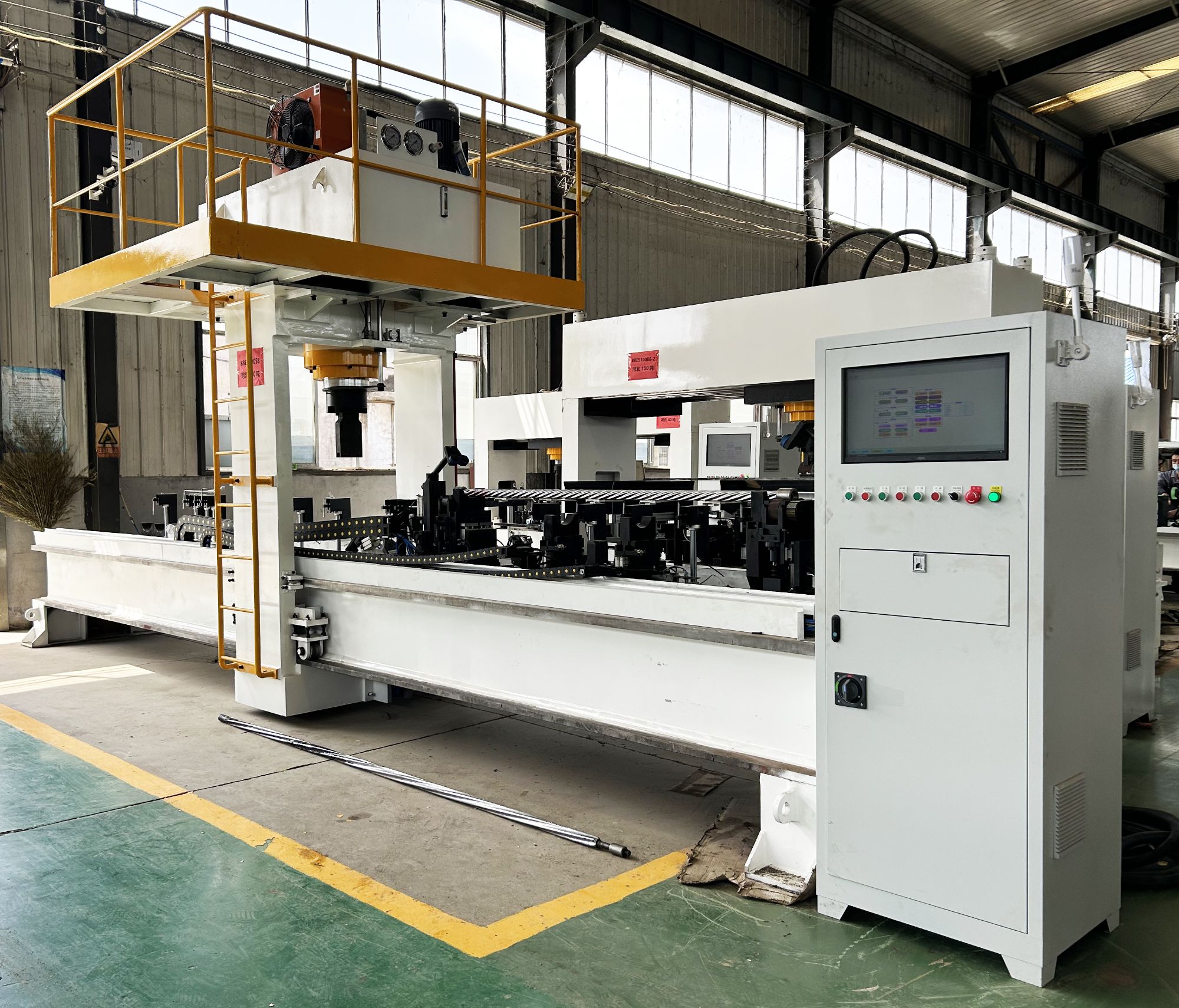
Inside a Press Type Straightening Machine
Measurement comes first
Before anything moves, the machine locates the pipe and measures it at multiple points along the length. Not one dial indicator at the middle — multiple points, because a pipe can have an S-curve or a bow that the center reading misses entirely. The inspection data becomes the press program. On our machines the straightening accuracy runs to 0.01 mm, and that figure only means anything because the measurement is resolved to the same order.
The press and the frame
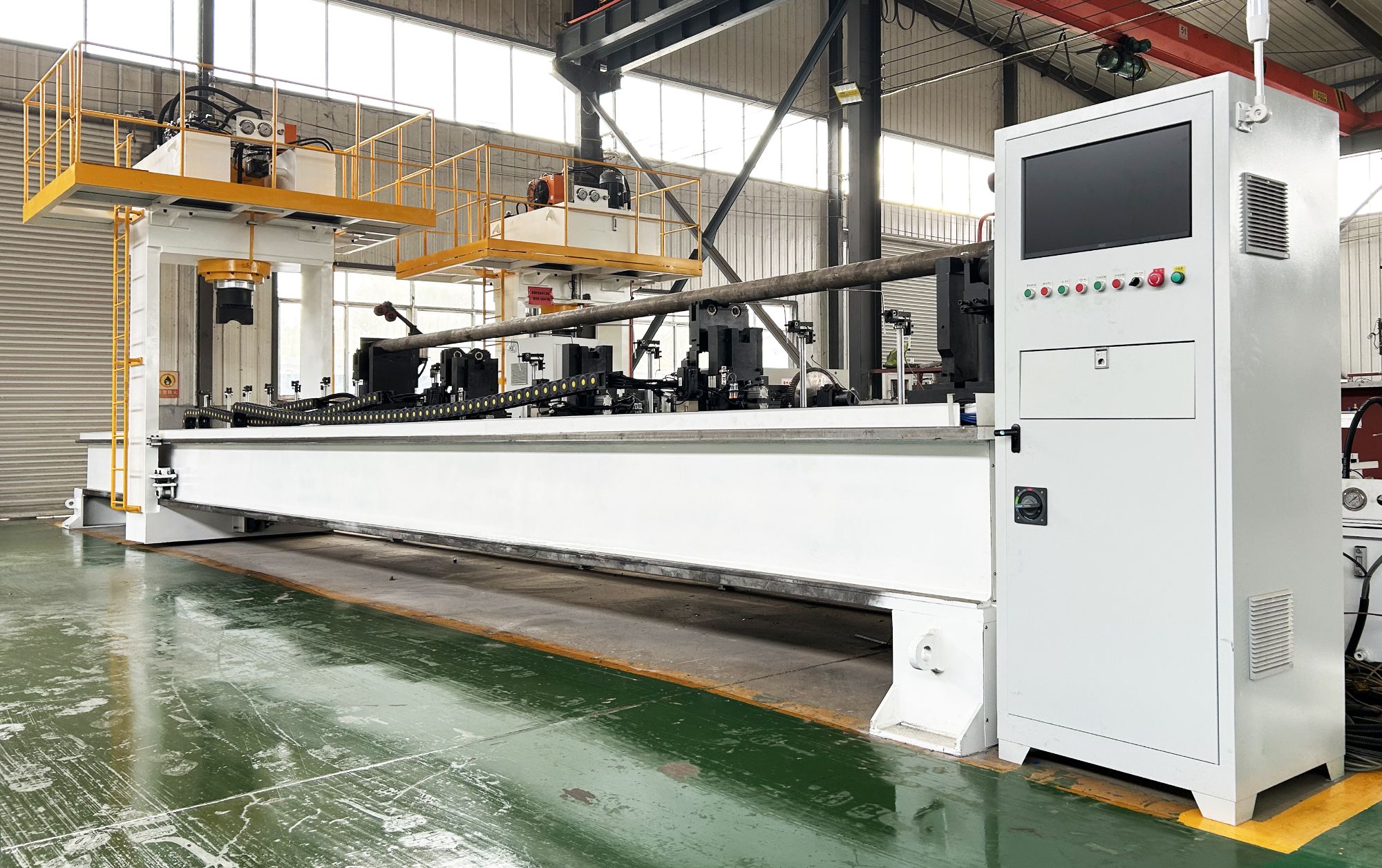
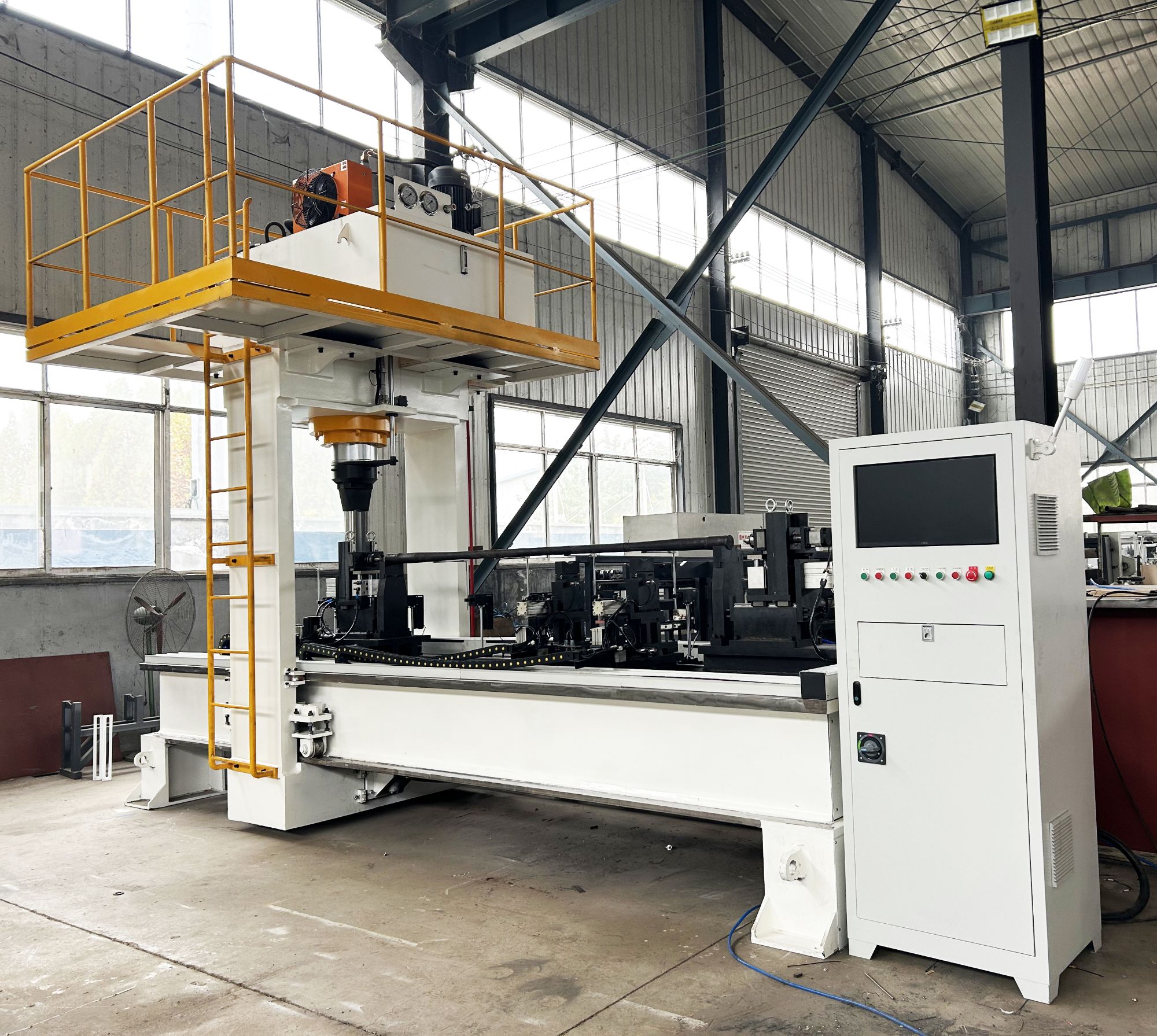
The press body is where tonnage lives. You'll see 200-ton units doing round bar and pipe work, and gantry frames at 315 tons and up for long, heavy workpieces — a 6-meter shaft needs a frame you can actually load from the side, not a closed C-frame you have to thread it through.
The control loop and the AI
This is the part that took us the longest to get right. A self-learning system watches what the press actually did versus what it was told to do, and adjusts press depth against springback on the next part of the same batch. Run 200 pipes of the same heat lot and the machine gets tighter as it goes, not looser.
Data goes out over MES if your plant runs one — per-part records, press history, measurement results. Useful when a customer asks why a specific serial number came back at 0.02 mm.
Getting parts in and out
Automation is where the labor math changes. Loading and unloading are handled mechanically, so a single operator can supervise several machines, and the line can run unmanned overnight. In practice, throughput lands around 3 to 5 times what a skilled hand-straightening operator manages, and it stays there on the night shift.
Sizing the Machine to Your Work
Tonnage is a starting point, not the answer. What decides the machine is your material's yield strength after heat treatment, the wall thickness, and how much initial bow you're willing to accept coming in.
| Workpiece | Typical press capacity | What really decides the choice |
|---|---|---|
| Heat-treated round bar, 20–80 mm | 100–200 T | Yield strength after quench, not diameter |
| Steel pipe, thin wall | 60–200 T | Pressure control matters more than raw tonnage |
| Long shaft, 4–6 m | 200–315 T gantry | Frame opening and support spacing |
| Square tube and profiles | Line-integrated | Tooling and handling, not tonnage |
One honest caveat: thin-wall pipe is harder than solid bar. There's less material to work with and a real risk of ovalizing the cross-section if the press is too aggressive. Ask any supplier what their machine does with your exact wall thickness before you sign.
Questions Worth Asking a Manufacturer
A press type straightening machine is a capital purchase you'll live with for a decade, so the conversation before the order matters more than the brochure. These are the ones that sort suppliers quickly:
- Can you run a sample of my own material and send me the measurement report? A demo on someone else's polished bar proves very little.
- What accuracy do you guarantee at my pipe diameter and wall thickness — not on your reference workpiece?
- How does the press contact the surface, and what radius do you use on coated or polished stock?
- How many measurement points, and does the machine re-check after pressing?
- What's the cycle time on a 6-meter pipe with 1.2 mm of initial bow?
- Can the data reach our MES, and in what format?
Service deserves its own question. Roughly 30% of our output ships to Brazil, Canada, Turkey, and Russia, and the difference between a supplier and a partner is whether someone answers the phone when a hydraulic valve fails on a Tuesday night. Ask who does the service in your region and how fast they can get to your floor.
Where the Demand Is Coming From
Steel pipe straightening used to be a fairly quiet corner of metalworking. Not anymore. Electric vehicle makers are specifying tighter runout on drive shafts and battery tray tubing. Liquid-cooled server components — the cold plates and manifolds inside AI racks — are pushing tolerances down because the coolant channels are narrow and a bent pipe doesn't seal. Aerospace and drilling tools have always been strict, and they're getting stricter.
That's the direction things are heading: fewer parts straightened by feel, more parts straightened by measured data you can hand to a customer.
What to Take Away
If you're fighting bent pipe, the fix isn't a bigger press and a steadier hand. It's measuring the part properly, pressing at calculated points, and checking the result before the part leaves the machine. Everything else — the tonnage, the gantry, the AI loop, the MES link — exists to make that cycle repeatable for the ten-thousandth part as much as the first.
Before you start comparing quotes, watch the video above again with your own workpiece in mind. Look at how much of the cycle is measurement versus pressing. That ratio tells you a lot about what kind of machine you're looking at, and whether the supplier is selling you a straightener or just a press.
If you'd rather talk it through, send us your material spec, wall thickness, and the initial bow you're seeing now. We'll tell you what's achievable — and if a press type straightening machine isn't the right answer for your part, we'll say so. Get in touch with our team and we'll run the numbers with you.