
Introduction: Why Liquid Cooling Tubes Need a Different Straightening Approach
If you work with liquid cooling loops for servers, EVs, or power electronics, you already know the problem. The tubing looks simple: round, thin-walled, often aluminum or copper, with tight bend radii and compact routing. But after bending, welding, or heat treatment, it rarely stays straight. A slight bow or twist can misalign a manifold port by enough to cause assembly problems, vibration issues, or even reduced coolant flow.
The video above shows an automatic straightening machine handling these parts in a live production environment. What you are seeing is not a manual press with an operator eyeballing a dial indicator. It is a measured, point-pressure correction process that checks the tube in multiple places, decides where to press, and applies force without leaving dents or scratches. I want to walk through why this matters for liquid cooling tubes specifically, and what to look for when you decide to automate.
The Problem With Straightening Thin-Wall Liquid Cooling Tubes
Liquid cooling tubes are not forgiving. Wall thicknesses often sit in the 1–2 mm range, sometimes thinner for compact server loops. The fluid channels need smooth internal surfaces, so any internal deformation can create flow restriction or cavitation. Externally, the tube must stay clean and round to fit through grommets, manifold blocks, and O-ring seals. A scratched or flattened section becomes a leak risk.
After cutting, CNC bending, brazing, or furnace brazing, the material carries residual stress. That stress releases unevenly, producing bow, twist, or ovality. Heat-treating can make it worse because the tube softens, and thin-wall sections move more easily during cooling. Manual straightening is still common, but it is slow and inconsistent. An operator may use a press, a mallet, or a simple V-block fixture. Each correction can over-correct, scuff the surface, or crush the tube slightly.
That inconsistency is the real cost. You might get ten good parts and then one that is 0.3 mm out in the wrong direction. On a liquid cooling manifold, that part may not seat properly against the cold plate, and you only find it during final assembly.
Why Manual Methods Fail on Small, Delicate Tubes
Manual straightening depends on feel. Experienced operators do exist, but they cannot repeat the same force at the same location hour after hour. Thin-walled liquid cooling tubes are especially risky because the difference between “corrected” and “collapsed” is small. A human press cycle often applies a single sharp impact, which can create point indentations. Those indentations are weak spots under thermal cycling: coolant heats up, pressure pulses, and the tube can crack or leak over time.
Automation solves the repeatability problem. An automatic straightening machine measures first, then applies a controlled pressing force. Because the force is not an impact, the tube surface stays intact. If the system is designed correctly, the tool contacts the part through smooth, radiused contacts, not sharp edges.
How an Automatic Straightening Machine Handles Liquid Cooling Tubes
At Shangda, we build automatic straightening machines around a simple sequence: load, measure, calculate, press, re-measure, and pass or reject. The machine uses multiple laser or contact sensors to inspect the tube along its length. The software builds a deviation map in seconds, then decides which points to correct and in what order. For a liquid cooling tube that is 300–600 mm long, the measurement cycle can be fast enough to keep up with a continuous line.
The correction itself is point-pressure, not full-length bending. That is important for thin-wall parts. Instead of levering the tube across two supports, the machine applies a localized force at the high spot while supporting the part nearby. This removes the bow without introducing new deformation. We use hydraulic or servo-electric axes depending on the force range and tube stiffness.
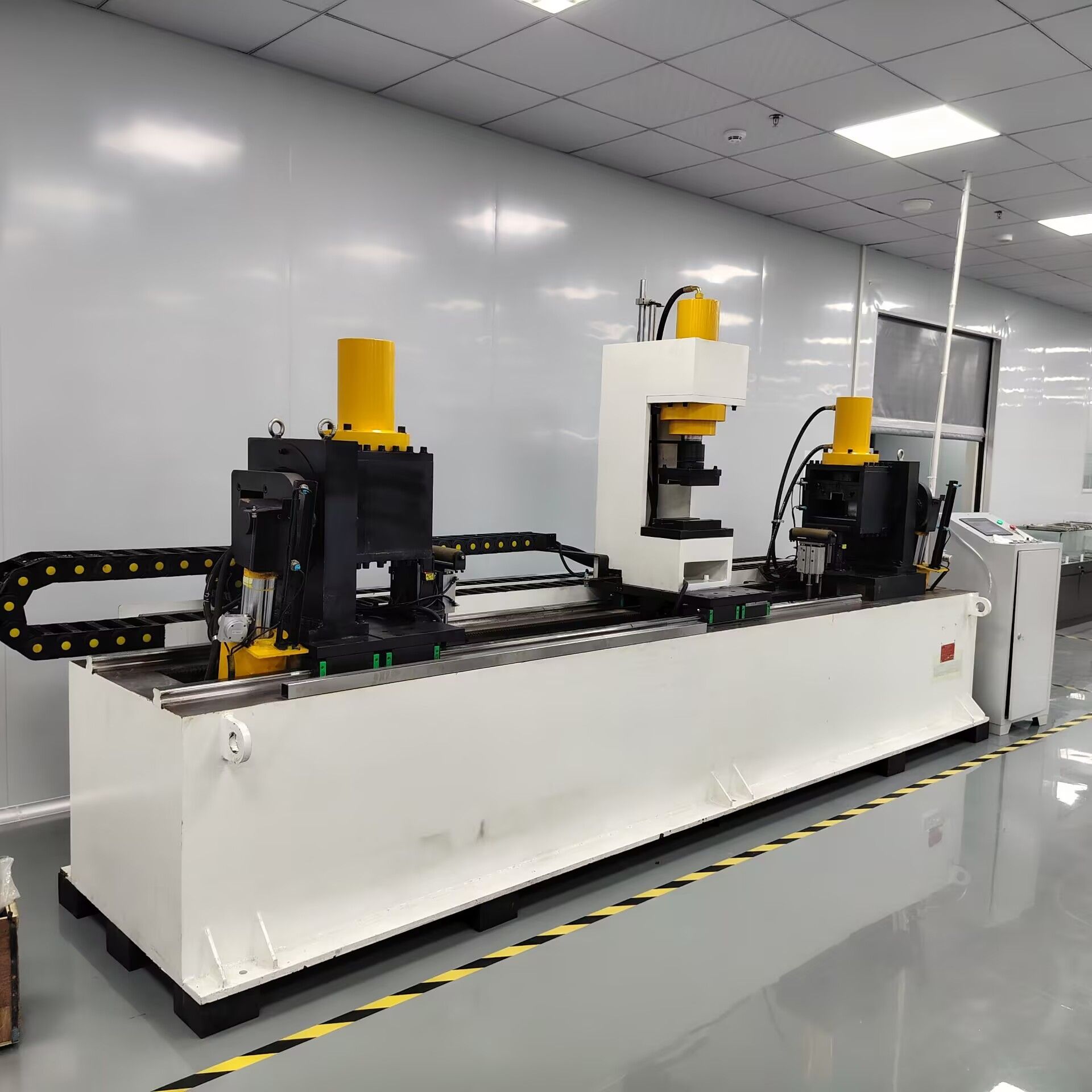
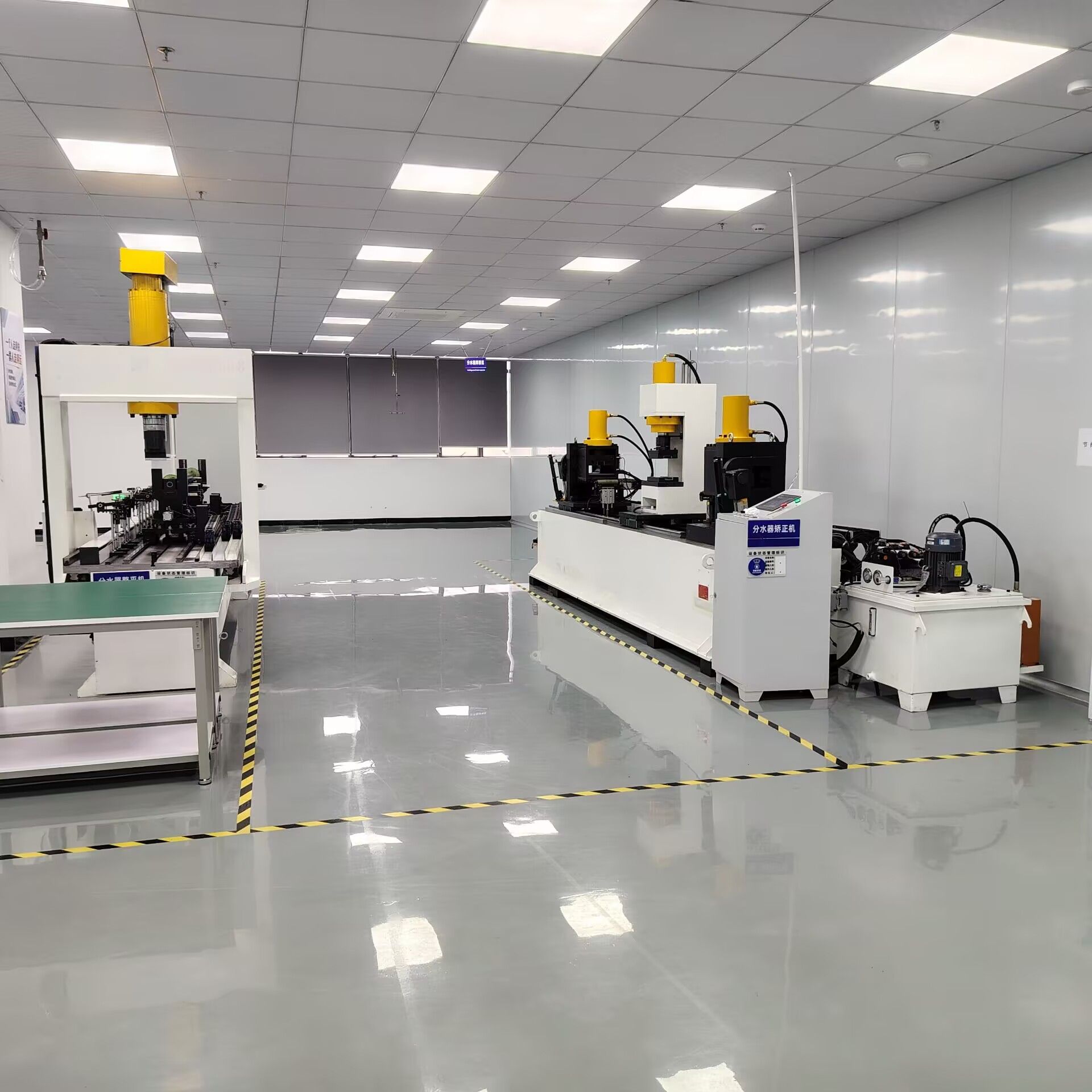
Those two images show the same idea from different sides: one is the complete correction station for water distribution pipes, and the other is the hydraulic pressing unit itself. You can see the tooling is not a hammer. It moves in a controlled axis, with the part held in position during the correction.
Measurement Accuracy and What 0.01 mm Actually Means
We talk about 0.01 mm straightening accuracy, and that number matters. On a liquid cooling tube, 0.01 mm of runout is tighter than most assembly tolerances. The machine measures at multiple points, so it does not just find the worst bow; it identifies twist and local ovality too. If a tube is twisted in addition to bowed, correcting only the bow can leave the ports at the wrong angle. The software handles this by computing a correction sequence that accounts for both conditions.
Because the measurement is inline, the machine can also sort parts. If the raw part is too far outside spec, the system flags it before pressing. That saves cycle time and protects tooling. If the part is within correction range, the machine works until it hits the target or reaches a correction limit.
Our AI self-learning layer improves this over time. It records each correction sequence and the final result, then adjusts the calculation model for the next batch. If the material supplier changes or the wall thickness shifts slightly, the machine adapts sooner than an operator would notice.
Key numbers: 0.01 mm straightening accuracy, 3–5× manual efficiency, 24/7 unmanned operation, one operator for multiple machines.
Why Connectivity and Unmanned Operation Matter
An automatic straightening machine for liquid cooling tubes should not be an isolated cell. It needs to talk to the line. We connect ours to MES, so every part gets a straightness record tied to its serial number or batch. That data is useful if a downstream leak test fails: you can check whether the tube was out of round before brazing. The machine also runs 24/7 without fatigue, and one operator can oversee several machines. In a busy cooling-tube line, that frees people for brazing inspection or leak testing, where human judgment is harder to replace.
What to Look for When You Evaluate a Machine
If you are shopping for an automatic straightening machine for liquid cooling tubes, start with your actual part range. Ask for the minimum and maximum outside diameter, wall thickness, and length. Some machines are built for solid shafts and heavy bars; they use too much force for thin-wall tubing. The wrong machine will crush the part before it straightens it. Ask the vendor to run a sample part, not just a demonstration on a solid bar.
Check how the machine handles mixed batches. Liquid cooling tube lines often produce several part numbers in a day. The changeover should be quick, and the software should store recipe parameters by part number. If the machine uses vision to identify the part, that is even better.
Look at the tooling. Contact points should be smooth and radiused. The clamping should not mark the tube. Ask about pressure control resolution. A hydraulic press that can only move in coarse steps will never hit 0.01 mm on a 2 mm wall.
Finally, ask about service and training. These systems are not complicated to operate, but the initial setup matters. You need a supplier who knows what to do when a new tube shape comes in. At Shangda, our engineers work with the customer’s part drawings and often run trials before installation.
Conclusion: Straight Tubes Without the Surface Damage
The goal is not simply to make a liquid cooling tube “look straight.” It is to produce tubes that fit reliably into cold plates, manifolds, and O-ring seals, without micro-dents, scratches, or thinned walls that fail later. An automatic straightening machine does that by measuring first, pressing at controlled points, and checking after correction. It removes the guesswork from a process that used to depend on an operator’s hand and mood.
If you have not watched the video above yet, go back and look at how the measurement and pressing cycle works in real time. The video shows the machine’s rhythm, but the details here explain what you cannot see: the multi-point data, the force control, and the in-process decision-making.
Want to discuss a specific liquid cooling tube or manifold? Talk to our team and send your part drawing. We will tell you if automatic straightening makes sense for your volumes and tolerances.