
Why shafts move after heat treatment
If you have ever pulled a shaft out of quench and seen it run out by a few tenths or even millimetres, you already know the problem. Heat treatment distortion is not a sign that your process is completely wrong. It is the part's response to thermal and metallurgical changes happening faster than the material can relax. You can reduce it, but you cannot fully engineer it away. That changes where you put your effort.
What actually drives the distortion
Temperature gradients
A shaft rarely heats or cools evenly. The surface sees the furnace or quenchant first, while the core lags behind. This creates a steep temperature gradient. Hot metal expands, cooler metal contracts, and when those two regions are stuck together in one part, internal stress builds. The result is bending, twisting, or ovality, depending on shaft geometry.
Phase changes and residual stress
As steel cools from austenite, it transforms to martensite, bainite, or pearlite depending on section size and cooling rate. Martensite occupies more volume than the austenite it came from. If the outside transforms while the inside is still hot and soft, those volume changes do not happen uniformly. You end up with locked-in residual stress. Later, when you machine or grind, that stress can release and the shaft moves again.
Geometry and clamping
Long, slender shafts are naturally more prone to distortion than short, stocky ones. Asymmetric features like keyways, splines, steps, and holes cool at different rates. Fixture clamping can become part of the problem too. If a fixture holds the part too rigidly during heating or cooling, it prevents free expansion and contraction, which adds stress instead of reducing movement.
Prevention vs. correction: where each one helps
Prevention is about reducing the magnitude of distortion before it happens. That includes optimising heating uniformity, using controlled quench rates, orienting parts to reduce asymmetric cooling, and designing fixtures that support without over-constraining. Stress relief tempering after hardening can lower residual stress, but it rarely eliminates all movement.
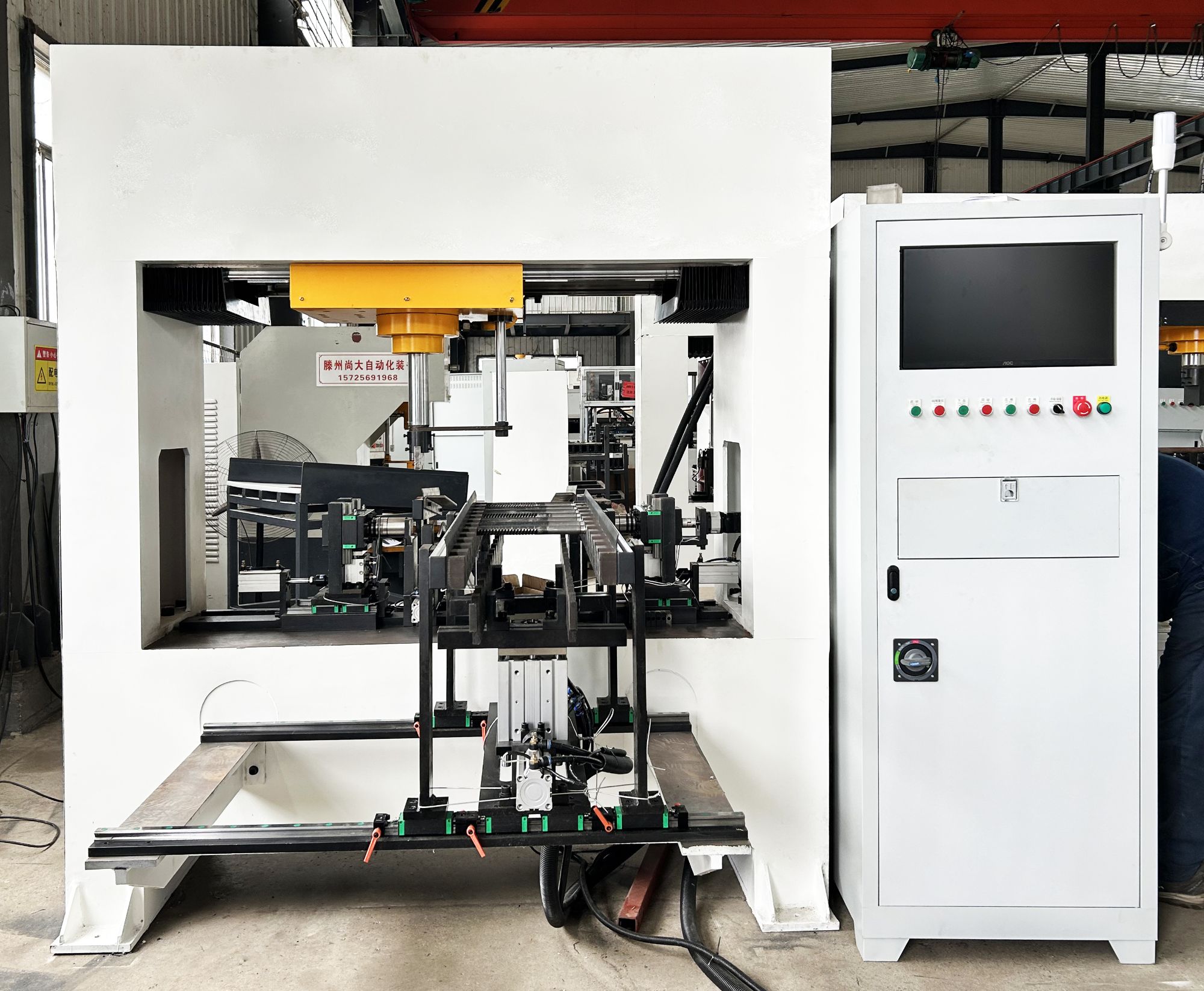
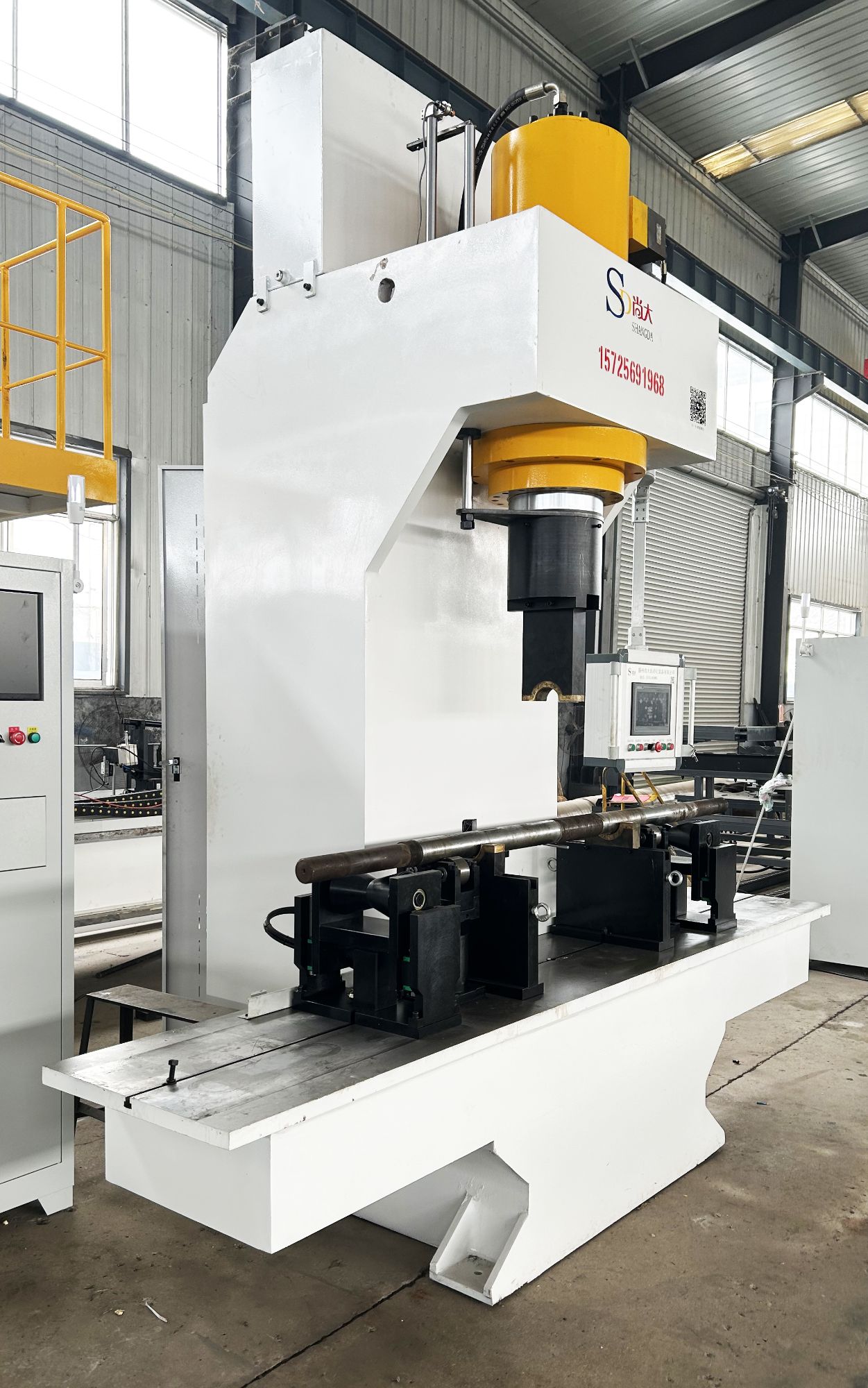
Correction steps in after the part has already moved. Manual press straightening works for small volumes, but it is slow and operator-dependent. Thermal straightening can be used on some parts but often changes local properties. Automated hydraulic straightening is different: it measures the shaft at multiple points, calculates where and how much to press, and corrects the bend with point pressure — no scratches or indentations.
| Prevention | Post-treatment correction |
|---|---|
| Uniform heating and controlled quenching | Automated hydraulic straightening |
| Stress-relief tempering | Manual press or thermal correction |
| Fixture support without over-constraint | Multi-point measurement and point-pressure correction |
Where hydraulic straightening is the final answer
Not every distorted shaft should be straightened. If the material is too brittle after hardening, or if the bend is too sharp for the section, straightening can crack the part. The practical boundary is simple: if the shaft has enough ductility to be pressed without fracture, and if the distortion is within a range that plastic bending can correct, automatic hydraulic straightening is a strong final process. That covers many heat-treated steel shafts used in motors, gearboxes, pumps, and similar power transmission parts.
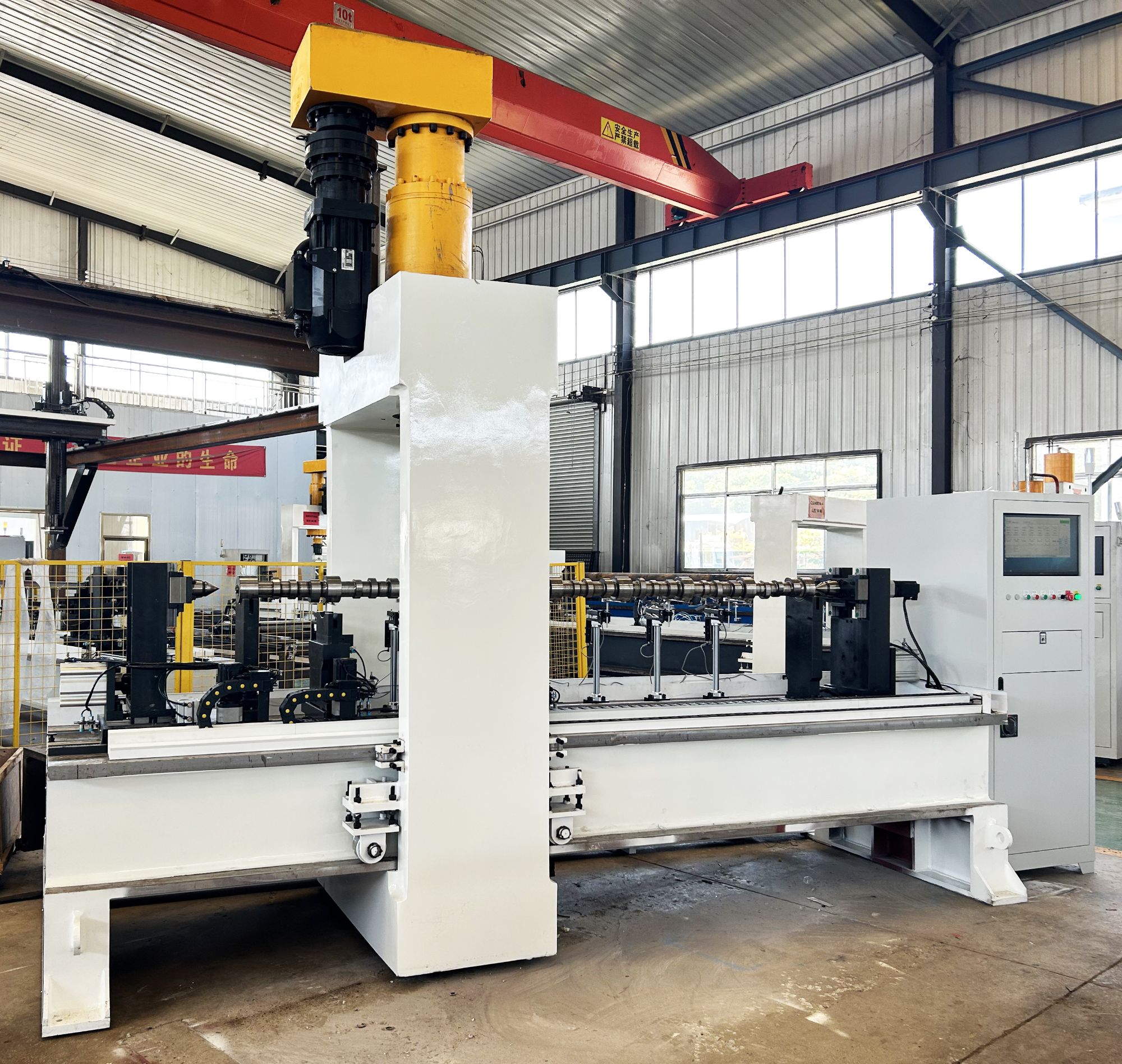
For these suitable shafts, automatic hydraulic straightening works as a final solution because it does not try to prevent distortion — it corrects the actual measured shape. Shangda's machines, for example, hold straightening accuracy up to 0.01 mm and run unmanned 24/7, with one operator managing multiple machines. Long or heavy shafts can be handled on gantry-style units, while a 200-ton press handles larger cross-sections.
Practical takeaways
Distortion after heat treatment is a process signature. You reduce it with good thermal practices and fixture design, but you finish the job with a correction step. For long, heat-treated shafts with enough ductility, automated hydraulic straightening is often the most consistent and economical final fix. If you want to look at your specific shaft geometry and heat treatment cycle, we can help you decide where straightening fits and where it does not. Talk to our engineers.