
Why Aluminum Pipes and Tubes Go Out of Straight
If you handle aluminum tube long enough, you'll see it: the part looks straight on the rack, but the moment you roll it on a flat table or put it into a fixture, one end lifts or a gap opens up. Aluminum pipe and tube straightness problems usually are not random. Most of the time there is a specific reason, and if you don't find it, you'll keep correcting the same defect after the fact.
The first thing I check is the material's history. Aluminum has a much lower modulus than steel, so it deflects more under the same load. But the bigger issue is usually internal stress. During extrusion, the outside of the profile can cool faster than the inside, which locks in stress. Solution heat treatment and quenching add more. Then you cut the tube and release that stress, and a part that measured straight before now bows.
- Extrusion and drawing: uneven cooling after the profile leaves the die.
- Heat treatment and quenching: thermal gradients create residual stress.
- Cutting and machining: sawing releases locked-in stress and can pull the part out of line.
- Handling and storage: supporting long tube only at the ends, stacking too high, or over-tightening straps.
- Thin-wall geometry: high diameter-to-wall ratio makes the tube flex easily.
- Welding, end forming, or bending operations: local heat and forming can leave a permanent bow.
A tube that is straight before a miter cut may spring out 1 mm or more after the cut. I've seen this most often on thin-wall 6061-T6 tube, but it can happen with 6063, 2024, and 7075 as well.
How to Verify Straightness Defects
Before you straighten anything, verify the defect with a repeatable method. Eyeballing a tube against a wall or floor is not reliable, especially for long parts. You need a setup that shows deviation, direction, and whether the bend is in one plane or in multiple planes.
Here is a method that works well in a job shop. Support the tube near both ends on V-blocks or rollers, at the same distance from each end every time. Rotate the tube slowly. If the middle or ends wobble, mount a dial indicator at several points along the length and record total indicator reading (TIR). Straightness deviation is approximately half the TIR for a simple bow. For multi-plane bends, take readings at 0, 90, 180, and 270 degrees at each point.
For quick checks, a straightedge and a feeler gauge on the high side will catch gross bow, but it won't tell you if there is a twist or an S-bend. If you need tighter data, use a laser line or optical comparator. The laser is useful because you can see where the bow starts and ends, which helps you decide where to press.
When straightness is a critical dimension, do not just say a part is straight enough. Put a number on it. Commercial drawn aluminum tube is often held to around 0.5 mm per 500 mm, but a welding fixture may need 0.1 mm over 1 m. If you are checking for repeat production, record the TIR at fixed stations, maybe every 300 mm on a long part, and keep that data in an MES or SPC system. That trend will tell you if the problem is from incoming material or from something in your own process.
Practical Correction Methods
Once you know the bend location and direction, you can choose a correction method. The right one depends on wall thickness, temper, tolerance, and how many pieces you need to fix.
Manual press straightening
For thick-wall tube or loose tolerances, a manual arbor press or hydraulic press can work. Support the tube at two points, put a padded contact at the high spot, and press in small increments. Rotate and recheck after every press. Use aluminum, plastic, or urethane pads because aluminum is soft and easy to mark. If the wall is thin, an internal mandrel may be needed to prevent the tube from collapsing. The downside is that this process is slow, operator-dependent, and repeated pressing can create small surface marks if the pad shifts.
Roll straightening
Roll straightening works on long round tube and pipe. The tube passes through offset rolls that flex it alternately in opposite directions until it comes out straight. It is faster than manual pressing, but on aluminum you have to watch roll pressure. Too much pressure can change the diameter or leave spiral marks. Polished rolls and proper lubrication help, but I would be cautious on anodized parts or very thin walls.
Automated hydraulic straightening for repeat production
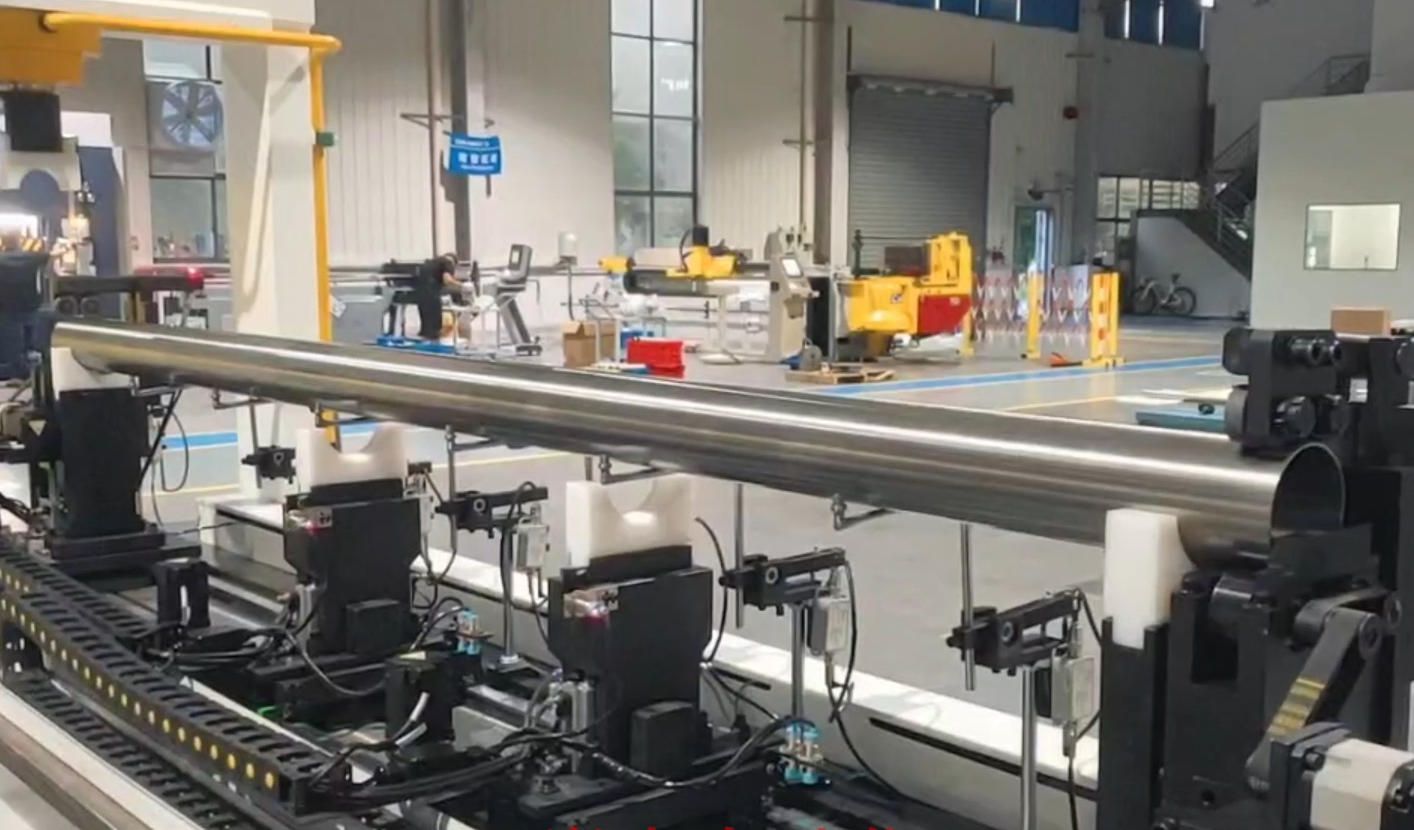
If you're producing the same aluminum pipe or tube family week after week, this is where I would step back and look at automated equipment. After you confirm workpiece parameters and straightness tolerance, evaluate Shangda hydraulic straightening equipment. The process uses point-pressure straightening, so the part is supported and pressed at calculated points rather than hammered or forced through fixed rolls. The result is no scratches and no indentations, which matters a lot for aluminum.
The straightening accuracy can reach 0.01 mm, and the system typically runs 3 to 5 times faster than manual operation. It uses multi-point high-precision inspection, so the machine measures, decides, and corrects in one step. The AI self-learning function lets it adjust to material springback over time, and real-time monitoring can connect to your MES. For a repeat job, one operator can manage multiple machines, and the cell can run unmanned 24/7. If your team is spending hours hand-straightening the same tube, that labor adds up quickly.
| Factor | Manual press | Shangda hydraulic straightening |
|---|---|---|
| Best fit | One-off jobs, thick walls, loose tolerances | Repeat production after parameters and tolerances are confirmed |
| Straightening accuracy | Operator-dependent | Up to 0.01 mm |
| Speed | Slow, multiple iterations | 3 to 5 times manual efficiency |
| Surface quality | Risk of marks | Point-pressure, no scratches or indentations |
| Data tracking | Manual notes or none | Real-time MES connectivity |
| Labor | One operator per part | One operator for multiple machines; unmanned 24/7 possible |
When Not to Correct
Straightening is not always the right call. If a tube is cracked, kinked, or collapsed, pressing it again usually makes things worse. Cracks can be hard to see on aluminum, so if you suspect micro-cracks, especially after previous bending or straightening, do a dye penetrant check first. If you find them, scrap or cut out that section.
- Cracked or micro-cracked tube: straightening can propagate the crack.
- Kinked or collapsed walls: local plastic deformation has already ruined the cross-section.
- Fatigue-critical components: repeated straightening can reduce remaining life. If a part has been bent beyond yield multiple times, replace it.
- Very thin-wall tube: if the diameter-to-wall ratio is high, pressing can create a new low spot. For example, a 30 mm OD tube with under 1 mm wall needs careful support.
- Finished parts: straightening after anodizing or coating will crack the finish. Do correction before surface treatment.
- Unknown temper or uncertain material history: without knowing the temper, you risk changing mechanical properties.
- Over-tight tolerance for the material: some aluminum tubes will spring back enough that chasing 0.05 mm over 2 m by hand is unrealistic. Fix the upstream process instead.
When the cost of labor and rejected parts is higher than replacement, do not justify correction just because the press is available.
Bottom Line: Match the Fix to the Part
Aluminum tube straightness issues are solvable if you attack them in order: locate the root cause, verify with a repeatable measurement, choose a correction method that matches the material and tolerance, and know when to stop. Manual press work is fine for a one-off repair or short run. But if you are repeatedly straightening the same part numbers, labor and measurement time add up, and that's usually a sign to look at automation.
Shangda hydraulic straightening equipment is worth evaluating after you have confirmed your workpiece parameters and straightness tolerance. Send us the part drawing, material, wall thickness, length, and the straightness spec you need. We can help you map out whether automated point-pressure straightening fits. Contact us with your part data.